Keto and Fasting
Keto and Fasting: two of the diet trends that everyone loves to hate. As someone who has worked in the health food and fitness industry, I’ve heard (and seen) some wild transformations from both of these. But I was yet to understand how either diets worked…until today.
The History of Keto
The concept of the keto diet was first introduced in 1914 after a pair of French scientists ran an experiment on epileptic patients.
Their belief was that epileptic seizures were brought on by “eating too much” – which, isn’t that just the French-est thing you’ve ever heard – and they tested this hypothesis by having 20 patients fast intensely. The patients would cycle through drinking only liquids (including the laxative sodium sulfate) for 4 days, then would eat a very low calorie vegetarian meal for another 4 days. Interestingly this actually worked, and lowered the incidence of severe seizures in patients [Höhn and Dozières-Puyravel, 2019].
Now, the Problem with this technique is that you actually do need sustenance to survive (don’t tell the French) so this solution was not sustainable.
Around the same time, fasting started gaining popularity in American culture.
Yes that’s right – America’s modern day fasting craze is over 100 years old!
And so are the fitness gurus who promote it.
Bernarr Macfadden (his book seen right) became an actual fitness influencer in 1899. Pre social media, this was primarily accomplished through publishing books and getting featured in magazines.
Macfadden’s influence on American culture was real, and he notably promoted fasting as a cure-all for any disease…and as a way to prove your superiority over other men [Griffith, R. Marie, 2000].

Now hold on, I want to also note that fasting for health reasons isn’t that new- it actually has thousands of years of history, with the first recorded treatment for epilepsy coming from Hippocrates in 500BC (2500 years ago), and another record coming from The Bible (yes That one), with a story from Mark about Jesus curing an epileptic boy with “fasting and prayer”.
But the resurgence of fasting in the 20th century by fitfluencers like Macfadden did leave its mark.
One osteopathic physician by the name of Hugh Conklin was influenced by Macfadden’s beliefs, and he began using fasting on epileptic patients [Wheless, James W, 2004]. Same as the results in France, the treatments worked!
Unfortunately Conklin’s theory was also as…let’s say dubious…as the French’s: he believed that your body is constantly secreting toxins into the lymphatic system and tissues (your own body poisoning you for fun and profit?), and that during periods of fasting the poisons would expel themselves from your tissues and …??? yeah… Let’s remember he was influenced by fitness gurus. Did I mention that Bernarr Macfadden died of a tummy ache because he didn’t believe in doctors? Let’s save that for another time.
Conklin’s successes spurred research on fasting for epilepsy in the 1920s, and soon physicians were on the fasting hype train.
With that being said, as mentioned earlier, people still need sustenance to survive! Children especially can’t be going on lifelong water fasts, they would never grow! Plus, even though their epileptic symptoms improved, patients were still getting maladies from not eating – like weight loss, low or irregular heart rates, and even maniacal symptoms [Rawle, 1921].

Enter the American physician Russell Morse Wilder.
Wilder was working at the Mayo Clinic in the 1920’s where he was “in charge of all diabetic patients” [Randall G Sprague; Russell Morse Wilder, 1960] (and yes it’s the same Mayo clinic that owns the web site where we enter our symptoms into today).
Wilder was fascinated by the effects of nutrition and metabolism on the body. After reviewing the research on fasting he realized that the reason epileptic patients were getting better could be dependent on a process known as ketonomia.
In his 1921 paper, Wilder noted that “ketoae bodies acetoacetic acid and its derivatives are formed from fat and protein whenever a disproportion exists between the amount of fatty acid and the amount of sugar actually burning in the tissues” [RM Wilder 1921]. (BTW look at this paper from 1921!!)
Basically, the process ketonomia occurs when your body has less sugar than fat to burn.
As a renowned diabetologist, Wilder was aware that ketogenesis doesn’t require pure water fasting. It can also be achieved by a diet high in fat and low in carbs. So he suggested a study using such a diet on patients with seizures occurring as frequently as twice a week or more.
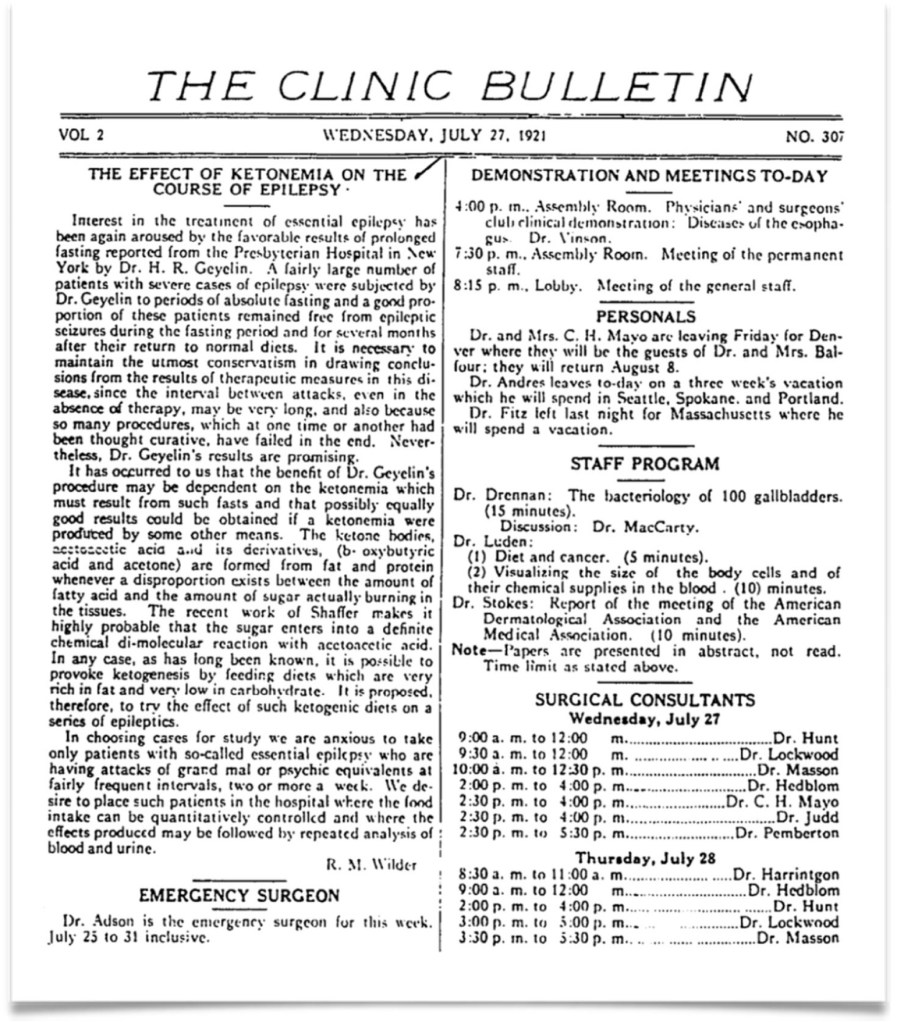
Then! Literally the next day – his first paper was published on Wednesday July 27 1921 and the next one was Thursday the 28th – he published the results of his own study on 3 patients meeting those exact requirements.
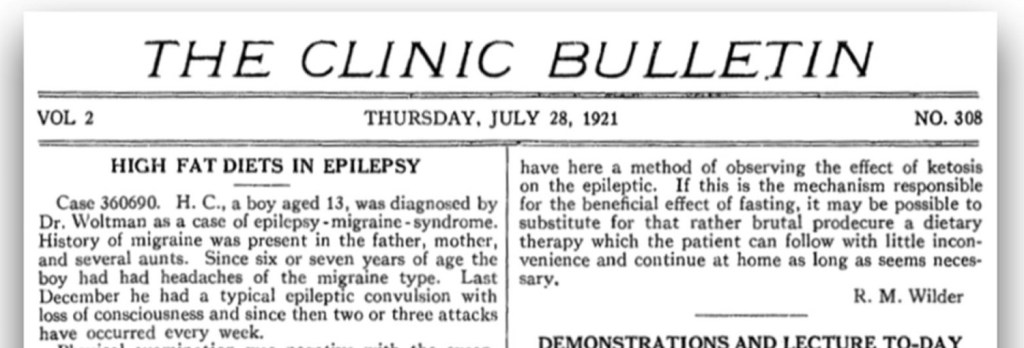
What an icon!
And all 3 patients reported two or more weeks seizure free on the high fat low carb diet. Wilder was right! And he proved it himself! People could eat and still reap the benefits of water fasting.
So, in the 1920s we discovered keto for epilespy works. Awesome!
Well, in the 30s they developed anti-convulsion seizure drugs, and obviously taking medication is easier than changing your whole diet so the whole keto thing died off for like 60 years (!)

Until the 90’s, when NBC made a limited series about the true story of a boy who didn’t respond to anti seizure meds and so the family tried keto. As we can imagine, keto was like a miracle cure for that little boy, and the tv show blew up.
It even became a Meryl Streep movie for some reason? (seen left)
And just like that, keto was In babey!
How Keto Works
So we know its results on epilepsy, but how does keto work?
Basically it all has to do with carbs. Carbohydrates get broken down in the body as glucose, or sugar.
There are two ways that your body is metabolizing fatty acids at any time. We have fatty acid synethesis which is regulated by insulin. Insulin, which you may be familiar with in terms of diabetes, is a hormone that is made to tell your body to absorb the carb-based glucose (sugar) from your blood and use it as energy. That’s fatty acid synthesis. When we eat carbs consistently, our bodies are comfortably converting carbs to glucose constantly.
carbs = insulin = fatty acid synthesis
The other way your body metabolizes fatty acids is fatty acid oxidation. In the case of a no/extremely low-carb diet, the body no longer has reason to produce insulin. As insulin levels drop, your body instead begins metabolizing fatty acids via beta oxidation. Beta oxidation breaks down those fatty acids and creates what scientists call “Ketone Bodies”. The increased presence of these Ketone Bodies is how we determine if someone is in “ketosis”.
That being said, the ketone bodies are always present in our blood, it’s just that when we fast, go keto, or even exercise really intensely, our bodies will produce more of it. [Ward, Colin 2015]
What are these “ketone bodies”?
There are three, the main two are acetoacetate (AcAc) and 3-Beta-hydroxybutryrate (3HB), and the third is acetone, which is created when AcAc is broken down. And by acetone I mean like literal acetone. And because acetone is released in the breath and urine while you’re in ketosis, some people can literally smell it on your breath as similar to nail polish remover, and those who are in ketosis can have the taste of something sweet or fruity [Laffel, L 1999].
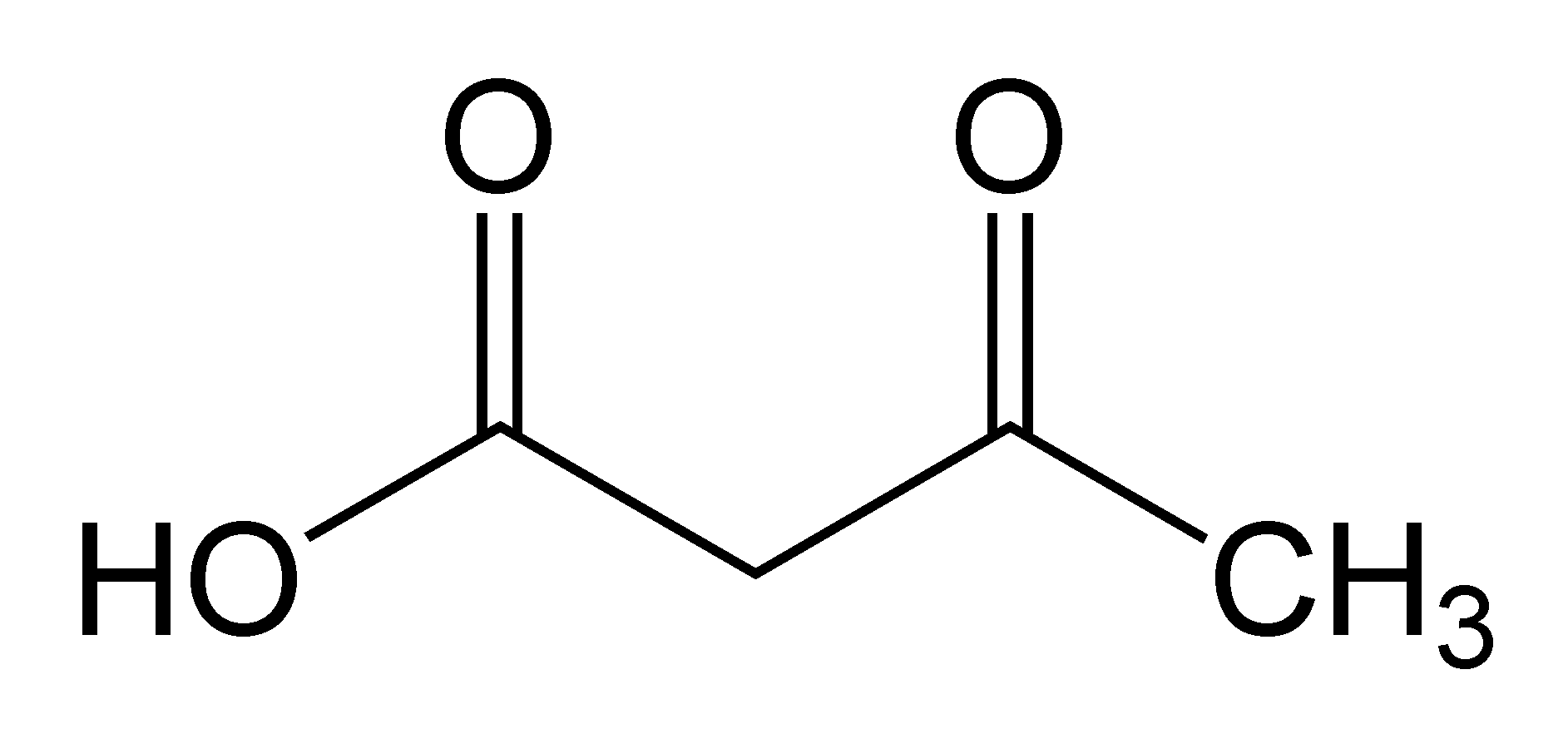
keto/fasting = low insulin = beta oxidation of fatty acids & ketosis.
In this case, the breakdown of fat becomes your main source of energy.
The fundamental aspect of burning fat for fuel means that keto compared to regular calorie restriction provides different results. Those in low calorie keto diets typically lose more fat and waist circumference than those in regular low calorie diets. In one study, more than 88 % of the group on a very low calorie keto diet lost more of 10 % of their initial weight [Moreno, Basilio, et al. 2014.]. In another, those on the low calorie keto diet lost over 2x as much waist circumference and nearly 3x as much weight as those on a regular low-calorie diet [Moreno, Basilio, et al. 2016].
Cool. We know the outcome and the what, but why?
Why is being in ketosis so fundamentally different than having a normal diet that it’s practically a miracle cure for epilepsy, and also touted as the cure to diabetes, obesity, inflammation [Kolb et al. 2021], cardiovascular disease [Venturini, Claudia, Lucia Mancinelli, et al. 2024], migraines [Di Lorenzo, Cherubino, Alessandro Pinto, et al. 2019.], Alzheimer’s [Huajun Yang, Wei Shan, et al. 2019] and even aging [Weindruch, R., and R. S. Sohal. 1997]?
Well thing is, fasting is starving, and starving is a stressor on your body.
In fact, the increase in energy from ketone bodies increases the production of radical oxygen species in your mitochondria (the powerhouse of the cell!) and we’ve all heard of the dangers of free radicals.
Ketosis causes oxidative stress, which also leads to an inflammatory response and cell damage. So what gives?
The reason is hormesis. Like myself, you’re probably familiar with this concept from pop culture.
Hormesis is the concept of introducing small levels of a poison to your body with the intention of becoming stronger, or more immune to it. It’s sort of like building a tolerance to alcohol! That’s a bad example. It’s like getting the flu shot every year. Or a more Bernerr MacFadden example: it’s like exercise. When you exercise it puts a lot of oxidative and inflammatory stress on the muscles you use, and as a result your body adapts itself to protect itself in case you do that exercise again. Really puts your 20 sets of 20 reps of bizep curls into perceptive eh?
Fasting
We’ve covered a lot on what ketosis is, and how the keto diet works. When you fast, you enter the same state of ketosis, or burning fat for energy, as you do in the keto diet. The primary difference? What fat you’re burning.
If you eat your standard calories on keto, then all of the fat you burn for energy will come from those calories. If you fast, then the fat you burn will come from your own body.
Of course, low calorie keto diets are also possible for weight loss, and have been documented as being very effective [Moreno, Basilio, et al. 2014.].
How do we fast? The switch from being in a standard carb-eating state to being in the fasted state and using fat, or Ketone Bodies, for fuel typically occurs after around 12 and 36 hours.
Which is kind of a big range if you’re trying to start fasting!
But the reason the range is so large is because it depends on how much glucose you already had in your body to burn when you start dieting/ketoing, and how much of it gets used up in your daily activity.
For example if you had a low carb diet on Sunday then did a 3 mile run Monday morning you’re more likely to be in ketosis by Monday evening than if you had a great big bowl of pasta Sunday night and skipped the gym on Monday [Anton, Stephen D., Keelin Moehl, William T. Donahoo, et al. 2018].
Now the fun thing is that most of us fast every single day, and we break it in the morning (that’s breakfast babey). By the time you eat breakfast, ketone bodies are contributing ~10% of your energy. By the 3rd day of fasting that number goes up to 25%, and after 5-6 weeks ketone bodies contribute to 2/3rds of your brain’s energy.
Those timelines sound pretty daunting, but long term water-only fasts have been gaining popularity recently.
There are over half a million people following the r/fasting page on reddit. It’s popular because those who suffer from obesity can make huge bounds and leaps in their weight loss journeys, and it’s been scientifically proven as well.

Just a 5 day fast has been shown to lower bodyweight from 4-6%, and longer fasts in the 15-20 day range can lead to 7-10% weight loss [Ezpeleta, Mark, Sofia Cienfuegos, Shuhao Lin et al. 2024].
That all sounds fun and wonderful, and people have been fasting for religious, health, and other reasons for thousands of years, but it doesn’t come without risk. Extended fasts have been shown to cause a decrease in bone density, alopecia (hair loss), Hyperuricemia (which causes gout and kidney stones), metabolic acidosis, and other such maladies.
In some extreme cases, death due to lactic acidosis, renal failure, and cardiac arrhythmia has occurred. However, those have only been recorded after very long fasts that lasted several weeks. And even then, there have been documented fasters who went without food for 14 weeks (like 99 days) and lost their weight and were fine!
Lean Fasting?
Now fasting and keto sounds amazing for those who have a lot of fat to lose. But what about people who are already lean?
Lets take a moment to address the bb’s in the room (that stands for bodybuilders btw).
Unfortunately there isn’t a lot of research in the effects of fasting on lean vs fat mass, and the few that exist didn’t do a followup, so all we know is the effects on the fast just before and after. And the results weren’t friendly to gains.
In one study, 10 days of fasting lead to a body weight loss of 7kg, or 15lbs, but of that, fat loss was only 3kg (6.6lbs) and the other 4kg (8.8lbs) was a loss of lean body mass. But again, the research is so so limited, and has only been studied in 8 and 10 day fasts [Ewa Ogłodek, Wiesław Pilis. 2021]. So scientists if you’re out there please, more research on body composition during and after fasts please. The people (me) want it.
conclusion
The reasoning behind the benefits to fasting & keto is that we evolved to shift from using glucose to using fat for energy after a period of starvation so that we could preserve muscle mass instead of wasting away and dying immediately.
Wild wolves only take down prey every week or two so they’re also capable of surviving on fasts. Current understanding of early humans suggests that we regularly went through periods without food. Similar to modern wolf packs, the evolutionary success of our ancestors would have depended on them being able to function both mentally and physically at a high enough level to remember where food is, communicate, make plans to gather and capture food, and be strong enough to psychically accomplish those plans. As Anton et al (2017) put so eloquently, “those individuals whose brains and bodies performed optimally in a food-deprived/fasted state would have a survival advantage.”
There are many health advantages to fasting outside of just weight loss, and these benefits have been recognized for a long, long time. Only in our current age are we unlocking the processes that impact our bodies during the fasted state. Are you willing to give it a try?
 Beautifully Boorish Science
Leave a comment